Friday, September 24, 2010

HP Slate prototype caught in the wild, booted to Windows 7


HP has done plenty of its own teasing of the HP Slate, but in-the-wild spottings are few and far between. Now our favorite YouTuber and yours, x313xkillax, has a video of an HP Slate prototype. (There's some speculation that this is a fake, but from everything we know about the tablet we're pretty sure this is the real deal.) The hardware looks similar to what we've seen before, though perhaps a bit further along than version Conecti.ca "reviewed" back in April. We're pleased with the boot time of the device and seemingly fine Flash performance, and x313xkillax calls the touchscreen very responsive, but as you can see in the video after the break, Windows 7 still isn't really designed for finger operation. Just like HP seemed to realize when it bought Palm and bumped this tablet from a consumer launch to a niche enterprise product.

View the original article here

High-Performance Computing Rules at GPU Tech Conference 2010

Nvidia’s GPU Tech Conference is evolving to have an even stronger emphasis on high performance computing than the past couple of years. Yes, there are token nods towards the consumer side of the business--Cyberlink is at the show, demoing 3D Blu-ray--but that’s about it. PNY is here, but showing its Tesla and Quadro based professional solutions.

If you’re into high performance computing, there’s some impressive stuff to be seen. As you wander around the show, there are a number of poster sessions which show off some of the research and high performance computing apps being created using GPU compute techniques like CUDA and OpenCL. Here are a just a few titles:

Black Holes in Galactic Nuclei simulated with Large GPU clusters in CAS (Chinese Academy of Sciences)Real Time Ultrasound Data Processing for Regional Anesthesia Guidance (Duke University Department of Biomedical Engineering)Exploring Recognition Network Representations for Efficient Speech Inference on the GPU (Department of Electrical Engineering and Computer Science, UC Berkeley)

Even the papers leaning towards more practical uses tend to seem academic. Take, for example, “GPU Accelerated Marker-less Motion Capture.” This is a Stanford University project that addresses how to accurately capture real-life motion of humans and animals without having to attach pesky, reflective markers. This is useful in animation and movie making, but could also prove useful in surveillance applications, but it sure sounded dry.

Similarly, “Real-Time Particle Simulation in the Blender Game Engine with OpenCL” is from Florida State University, but it’s really aimed at people learning techniques for building more realistic games.

It’s clear that Nvidia’s emphasis for the GPU Tech Conference is on the “tech” in the title. Unlike the Intel Developer Forum, which is more targeted at building the entire ecosystem for all Intel products, the core emphasis at GPU Tech Conference is on high performance computing.

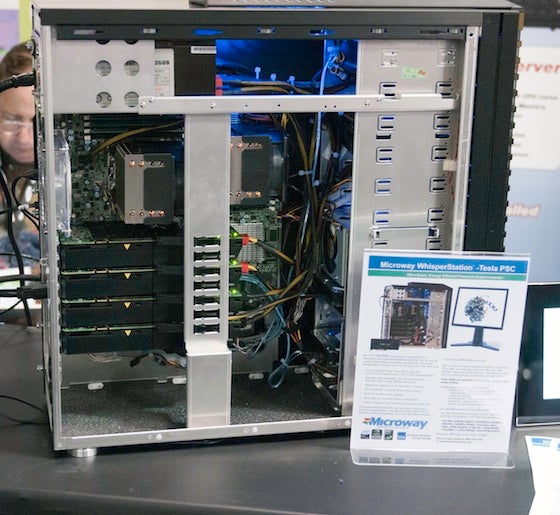
Wandering around the San Jose Convention Center show floor, the exhibits tended towards high performance computing applications and hardware as well. The MicroWay WhisperQuiet Tesla Personal Supercomputer was pretty much the average system on the floor:
Even gaming applications like competitive online racing seemed to emphasize a more professional bent. This is not your father’s NASCAR Racing game:

I notice that in the keynote, the atmosphere was more muted. There was cool stereoscopic 3D stuff, most of the time was taken up with relatively esoteric discussions of ray-traced renderers, details about physical simulation using ANSYS and several other interviews in a similar vein. Gone were the punchy jibes at competitors from Jen-Hsen Huang that have punctuated the news coming from past GPU tech conferences.

Maybe that’s how it should be. As Nvidia responds to competitive pressures, it’s natural to move into areas not served by competitors. AMD’s graphics group certainly has some presence in professional graphics through its FireGL line of graphics cards, but its penetration into the compute segment served by Nvidia’s Tesla products is miniscule.

Intel’s Sandy Bridge CPU line, slated to ship early next year, will put pressure on Nvidia’s entry level GPU products. Consumer level applications, like video transcoding, will be very well served by Sandy Bridge. At least one observer commented that Sandy Bridge’s video encoding is much faster than anything by Nvidia and possibly better quality. If Nvidia can’t compete with entry level, it’s natural to move higher up in the product food chain.

And although the tone this year seems more sober and serious, it’s also a more mature tone. Announcing a road map that goes out for three more years implies a fairly rigorous product planning process – although once again, that roadmap focused on GPU compute – no roadmap of the mobile Tegra processor line was evident.

As Nvidia, AMD and Intel jockey for position in the various market segments for visual and high performance computing, it’s increasingly clear that Nvidia is also dependent to a great degree on Intel. Intel logos were quite visible at a number of booths in the GTC trade show, and Huang suggested that the CPU and GPU would not only co-exist, but co-operate in the high performance compute space going forward.

Perhaps the final irony at this year’s GPU Tech Conference was the tiny booth occupied by SGI. The former workstation giant, at which many of Nvidia’s leading architects and engineer cut their teeth years ago, is now an outlet for Tesla-based compute servers. SGI’s presence is perhaps a sobering reminder of how even high flying tech giants of the past may one day be just a small exhibitor depending on some upstart’s product line.

Tweet

View the original article here

Thursday, September 23, 2010

Can’t Code? No Problem. Come To The Hackathon Demos This Sunday

This Saturday, hundreds of hackers, designers, and entrepreneurs are going to descend upon the San Francisco Design Center Concourse for the TechCrunch Disrupt Hackathon. There will be pizza, caffeine, beer, and MacBook Pros as far as the eye can see. Most of the participants won’t leave (and many won’t sleep) until 11 am the next day, when each team will have 90 seconds to present what they’ve created to our expert panel of judges.

This demo session is free and open to the public, and it’s really something to see. An analogy: if the Startup Battlefield at Disrupt is “Who Wants To Be A Millionaire”, this demo session is “Jeopardy!”. No frills, no extras, no lifelines or waffling over whether to take the money, just pure unadulterated content. Wow us in a minute and a half and let’s move on to the next one. The winner gets a spot on stage at Disrupt.

You don’t need to have stayed overnight or even have participated in the Hackathon to come and see the results on Sunday. If you do come check it out, you’ll be in good company and might even meet some of our expert judges:

Cyan Bannister
Brett Bullington
Rebekah Cox
Chris Dixon
Bradley Horowitz
Dean Hovey
Michael Marquez
Christopher Poole
Joshua Schachter
Mike Schroepfer

And of course, if you’re not really the spectator type, there are still a few slots left to actually participate in the Hackathon, so sign up here for your shot at presenting on stage at Disrupt.


View the original article here

Microsoft Xbox Chief Predicts Doom & Gloom For Blu-ray [He's Right, Too]


Once upon a time, Microsoft backed a format called HD DVD and, well, that didn’t turn out so well. But the departure from focusing on high-density physical media early on might have forced Microsoft — and the Xbox team — to look towards digital downloads for future products. UK Xbox chief, Stephen McGill, seems to agree and recently stated to gaming site Xbox Achievements that “People now recognize what a smart decision it was to keep the [Xbox 360] pricing low,” in reference to not including an advance optical format within the Xbox 360. Then he goes on to properly slam the Blu-ray format.

Read the rest of this entry »


View the original article here

Nvidia’s CUDA to Support x86 Processors

On Tuesday, Nvidia announced it was going to support x86 processors as a target for CUDA applications. This means that apps that are currently written to support Nvidia’s GPU line for compute applications will be able to run on standard x86 CPUs--no GPU needed.

Today, I spoke with Mathew Colgrove of The Portland Group. The Portland Group specializes in compilers for high performance, parallel computing applications. A subsidiary of ST Micro, Portland Group focuses mostly on a version of Fortran designed for multiprocessor systems. As a programming language, Fortran is still heavily used in the scientific computing arena, and leans heavily towards making procedural computation – it’s not meant to be a general purpose language like C or C++.

Colgrove noted that the initial version of the x86 CUDA Fortran would focus on multiprocessor AMD and Intel CPUs, and take advantage of the latest versions of SSE for floating point. He also said that they had working simulations of Intel AVX (advanced vector instruction) versions of the compiler in the lab. So when Intel ships their Sandy Bridge CPUs with AVX support, parallel applications should see a substantial performance boost.

I also asked Colgrove if AMD GPUs could be targets for CUDA applications, but he replied that they had no plans to support AMD’s GPU line. “We’d love to be able to support AMD GPUs, but we’d need a lot of support from AMD, something that hasn’t been forthcoming.

Supporting both Nvidia GPUs and x86 processors will eventually allow applications developers to build software with a single binary that can run on mixed systems (x86 + GPU) and systems that lack GPU hardware.

It’s interesting that Nvidia would lend a hand to this effort. While CUDA apps will likely run more slowly on x86, CUDA’s proprietary nature has been something of a competitive advantage for the GPU-oriented company. Given emerging standards for compute APIs, like OpenCL and Microsoft’s DirectCompute, perhaps Nvidia felt it needed to support other processor technologies to avoid being left behind.

Follow GeekTech on Twitter or Facebook, or subscribe to our RSS feed.


View the original article here

Review: Nav9 Windows 7 Tablet


Spoiler: It’s a Windows 7 Tablet. If that makes you laugh derisively, then the product isn’t for you. It’s a decent netbook replacement, bringing its own advantages and disadvantages to the table, and while you may (rightly) mock its usability, you can’t deny its versatility.

Read the rest of this entry »


View the original article here

Thursday, September 2, 2010

HP Pavilion DV6000 Broken, Guy Gets Even (Funny Video)

HP DV6000 Laptop Pavilion Guy Gets Even .... Tech behind the counter obviously told him the laptop was no longer under warranty and he had the dreaded black screen, don't get this frustrated with your laptop ... fix it yourself with the simple HP Pavilion DV6000 series Penny Fix


If The movie does not show heres the LINK to it

Copper shim no video fix HP DV60000


Lone Star Custom Lapel Pins

Lone Star Custom Lapel Pins
Veteran Managed Lone Star Pins are creators of custom lapel pins. We offer a free digital how to PDF on our site, Free Artwork, and quote. Contact us today for your proof and quote.

Share

Twitter Delicious Facebook Digg Stumbleupon Favorites More